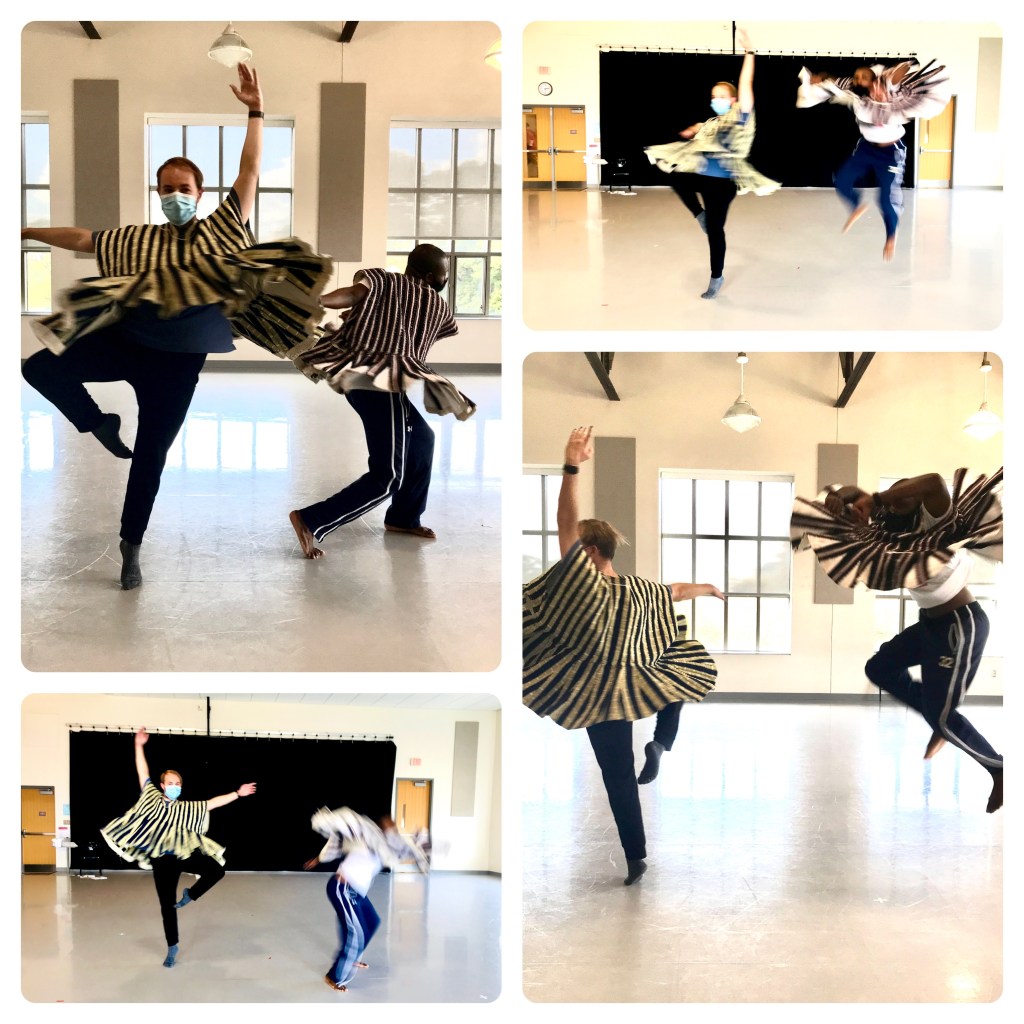
The Ghanaian Smock also known as Fugu/Batakari is popularly worn by Chiefs and people in the Northern part of Ghana where it originated from but it is now widely worn across the entire country. It is the costume for some dances in the Northern part and the most popular is Takai. The smock exhibits its glamour when the dancer does spiral movements. This made me curious to experiment how it will look on a ballet dancer.
John Cartwright is a colleague in the MFA program here at OSU, and being a very good ballet dancer, I decided to go on this quest with him. I spoke to John about a collaboration and he eagerly jumped onboard. I had been listening to songs by a French Afrobeats artist called Hiro and his “Motema” song really moved me and I wanted to choreograph to it. I shared the song with John and he offered to explore some ballet movements that fit the song while I also offered to develop African dance movements specifically from Ghana. We met for the first time, shared ideas and tried out some movements, it was a great start and we were empowered by the materials we had, and kept exploring. We had a week to finish up this project and present it in our Choreography Workshop class so we had to keep experimenting and bringing out ideas. We both had different schedules and that meant limited time to meet and rehearse. On our second rehearsal, we had a solid piece which was ready to be showcased in class. The second and last rehearsal was very vital as we had to dance with the costume because that was the icing on the cake. I have danced in smocks several times but I knew John had to rehearse with it in other to be very comfortable in it during the performance since it was his first time. John’s first impression when he held the smock was “wow this is very heavy”, “yes the smock is a heavy attire/costume”, I replied. I made him move about with it for sometime till he got comfortable. The ballet movements and traditional Ghanaian movements looked great with the costume on and we were ready to present it in class.
We presented it in class and the feedback was great and this is definitely a piece I would love to develop in future. I would like to experiment it on ballet dancers to use the costume for a full ballet piece. Also, I would like to develop the idea of ballet movement and African dance movements further and this might be in the near future. Thanks to John on working on this piece with me, I hope we develop this piece soon. Here is John’s block post about our exploration and adventure.
This project provoked a few questions about male identity in dance: what is masculine movement? What is feminine movement? How do the clothes or costumes we wear influence the movement and the audience’s perception of the performer(s)? What does it mean to see two male identifying bodies dance together? How do different cultures perceive what is masculine and what is feminine?
 The Creative Process